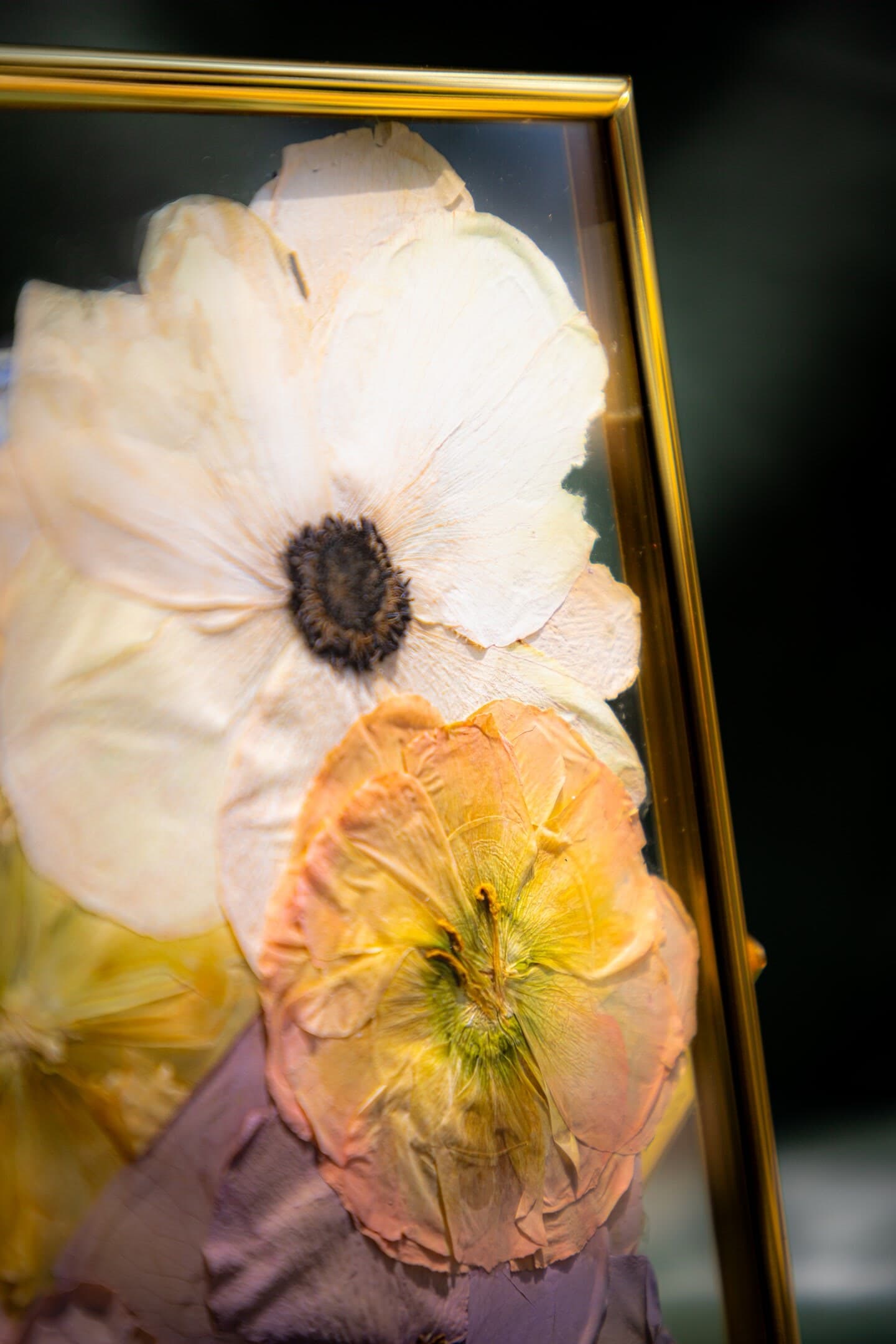
This is exactly what happens to your bouquet from the moment you let it go until it returns to you.
01
Book your preservation (before the wedding)
When you confirm your bouquet with your florist — or with us — you reserve your place in the atelier with a 30% deposit. This is the step that protects your keepsake most: flowers don't wait for you to decide later.
02
Your bouquet arrives at the atelier
Within the first 72 hours after the event, and the sooner the better. The route isn't decided by which state you marry in: it's decided by how long your bouquet takes to reach the atelier. If you're less than two hours from Atlixco — Puebla, Cholula, Tlaxcala — there are three options and none is the default: you hand it to us, we collect it, or we meet at a midpoint. Farther than that, it travels by express courier and insured, and we tell you exactly how to pack it; that shipping is at your expense, and within those two hours there is no freight to charge, because there is no third party on the route. One rule governs both routes: stems drinking, petals dry. The bouquet drinks through the stem, and water on the flowers rots them, yellows them and grows mould. If your bouquet has already dried, write to us anyway — we assess case by case, under the conditions that apply to that scenario in our policies.
03
Flower-by-flower assessment
We review every stem: which flowers are at their peak, which need rescuing, and which will tell your story best in the piece. We share the proposal with you before starting.
04
Drying and pressing
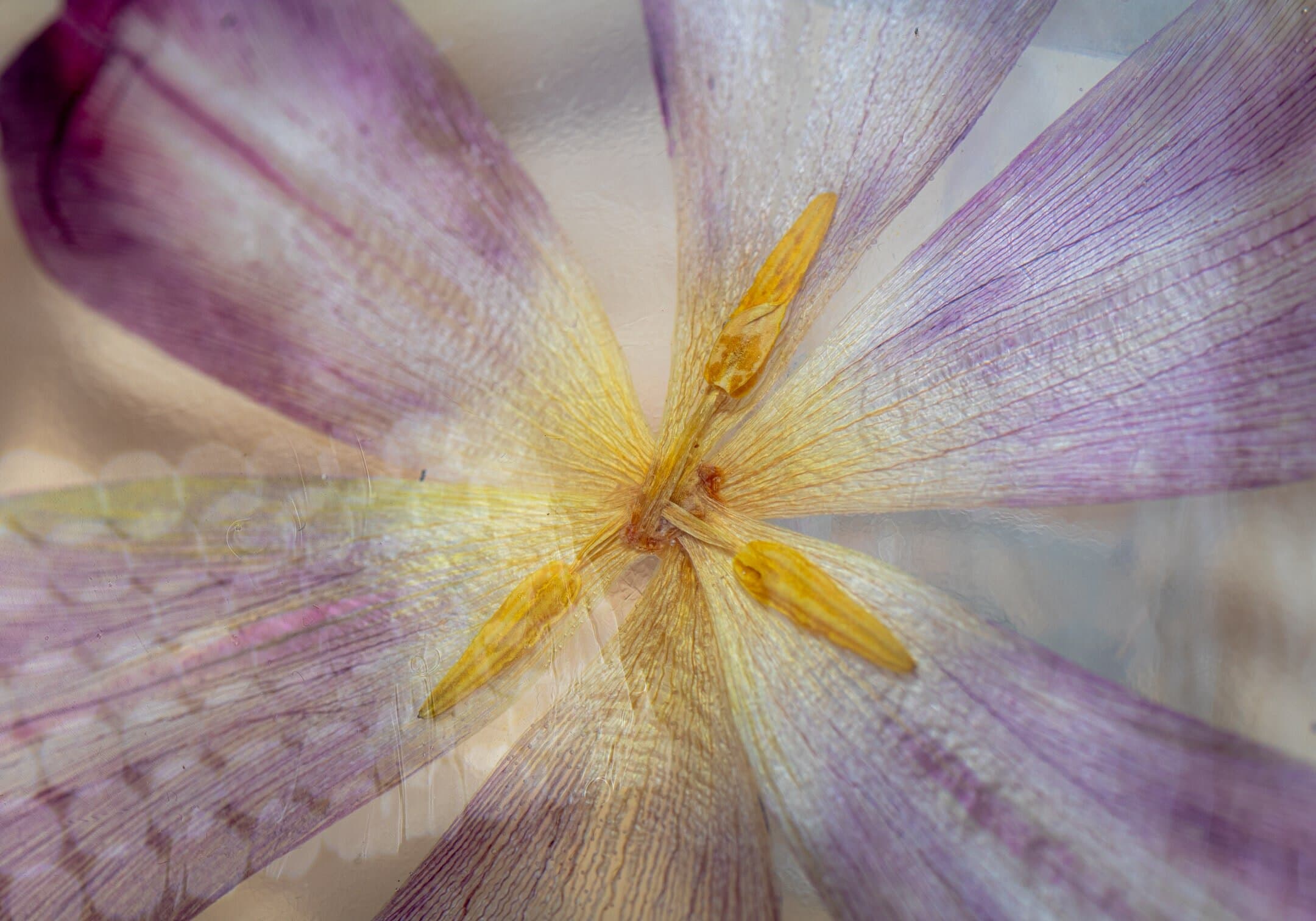
Each flower is dried with the technique it calls for — pressed between layers of controlled pressure, or dried in silica gel for the resin pieces. This is where the shape is set. The color always shifts: it turns paler, sometimes uneven. That's what drying does, and it's why the next step exists.
05
Color correction
It's included, and it's almost always needed. We bring back by hand the tone the drying took away, flower by flower, as close as we can get to your fresh bouquet. It's a painter's job, not a restorer's: we're after the likeness, not an exact copy.
06
Composed by hand
Fernanda, director of Eternals, composes your piece flower by flower. No two are alike, because no two bouquets are alike.
07
Curing and finishes
The resin is poured in thin layers with days of curing between each one — that's why the total time is 6 to 8 months. A pressed-flower frame takes 4 to 6 months, depending on the season. Art can't be rushed; we share progress along the way.
08
Your piece comes home
We let you know the moment it is finished and we decide together how it reaches you. If you are less than two hours from the atelier, you collect it here, we bring it to you, or we meet somewhere convenient, at no charge and subject to the atelier's availability. From farther away it travels packed, with a trackable label and insured for its declared value: that shipping is at your expense and we confirm it with you — cost, address and conditions — before it leaves. It comes with the care instructions for your piece.
Your city is not an obstacle. It is one more detail of the journey.
Frequently asked questions
Before the wedding — caring for your bouquet
The bouquet we preserve is the one that walked with you — not the one that flew through the air. For the toss, ask your florist for a separate bouquet: the tradition is honored just the same and yours reaches the atelier intact. Bruised petals don't show on the wedding day; they appear later, under the resin.
No — it's the one thing we truly ask of you. A household refrigerator isn't made for flowers and the freezer is far too cold: on coming out, the bouquet wilts and mold appears within hours. We can't accept bouquets that have been through either. If it already happened, all isn't lost: ask your florist for a miniature version of your bouquet and we'll preserve that one.
Stems in water whenever you're not holding it — and only the stems: water on the petals rots them, yellows them and grows mould. An inch or two of water in the vessel is enough; filling it doesn't hydrate more, it drowns. Never mist the flowers. Once the party is over, untie the bouquet and take off the ribbon: bound tight, the flowers can't breathe and begin to rot from the inside. Away from direct heat, and never left inside the car while the party goes on — heat concentrates there and dehydrates in minutes. Touch them as little as possible, since the oil from your hands marks them. When packing it, never wrap the flowers in plastic: it becomes a heat chamber. Some bruising is inevitable and to us it adds character.
Not the succulents. They're full of water and shrivel like raisins as they dry — and resin needs everything completely dry. If your bouquet mixes flowers and succulents, keep the succulents to plant and send us the flowers: you keep both, one alive and the other forever.
The stems travel drinking and the flowers travel dry — the same rule as always, solved for a box. Wrap only the base of the stems in cotton or paper towel that's damp, never soaked, and slip that base into a bag closed with a rubber band around the stems. That way the bouquet drinks the whole journey without a drop reaching the petals. No loose water inside the box: couriers prohibit it, and it soaks the flowers, which is exactly what rots them. Then a firm box where the bouquet lies down and is held by the stems, with the gaps filled with crumpled paper so it can't shift. Never plastic wrapped around the flowers, never bubble wrap against the petals. Label the box “Fragile — fresh flowers” and “This way up”, and send it by express courier the first business day after your wedding — if you marry on a Saturday, that means Monday morning. This is the real reason for the hurry: more than thirty hours pass between the last photograph and the courier's counter, and transit only starts counting after that. Let us know before you send it: every shipment is scheduled with the atelier, so we know when to be ready for your bouquet. And insure the shipment for the value you declare: the basic coverage couriers include is not enough, and a bouquet lost without insurance has nothing to be replaced from. We walk you through every step on WhatsApp.
There's a way out, and more than one: your original florist can remake the bouquet and send it to us fresh, we can design the replica in our atelier, or compose it with dried flowers from our inventory if we have what's needed. If the damage is light — a few wilted or bruised flowers — we can almost always preserve it as is. And if the courier runs late, that delay is not held against you: we assess the bouquet by the condition it arrives in, not by the day it arrived. Write to us and we'll look at your case; the details live in our refund and rescheduling policies.
Your piece, from the inside
Roses, ranunculus, lisianthus, peonies and most wedding flowers respond very well. Some very watery flowers (certain orchids, for instance) call for special technique — we assess them flower by flower.
Yes, always. No flower comes out of the drying with the color it went in with: it turns paler and sometimes uneven, with some areas lighter than others. Each one in its own way — whites take on ivory tones, reds and burgundies deepen, and some tropicals may darken or not survive the drying. Translucent spots can also appear, and the flowers settle a little as the resin is poured. That's why color correction is included in the process and is almost always needed: it's the step that gives back by hand what the drying took away. Your piece is real flowers, not a photograph, so what we're after is the likeness to your fresh bouquet, not an exact copy.
Handwork that returns your flowers to the tone they had when fresh and conceals most of the bruising. It's included and almost always necessary, because drying always washes the color out: it isn't an add-on you pay for separately or something you have to ask for. It matters even more on white orchids, anemones, white flowers, tropicals and red roses, which change the most. One single exception: it can't be applied to air-dried flowers.
Three, at no cost. We prepare them with the flowers from your bouquet that survived best and send them before assembling anything; we adjust until it's yours. If you'd like to explore more directions, each extra proposal costs $250 MXN. And if we don't hear back, we proceed with the design we have on file — though we'd a thousand times rather you tell us what moves you.
We choose the healthiest and most beautiful for your piece: in a composition, judgment weighs more than quantity, and naturally between 10% and 15% of the floral material is lost in the process. The flowers that don't make it in aren't returned. If you want to use the whole bouquet, the answer is a larger format or a second piece — we'll tell you honestly when we assess your bouquet.
Yes: the invitation, a ribbon, lace from the dress, a letter. Tell us what holds your story and we'll work it into the design.
Yes. Write to us and we'll add it to your order: while your bouquet is in the atelier we can assess whether there's enough for another piece. The same bouquet can live in more than one.
Away from direct sun and extreme humidity; clean it with a dry, lint-free cloth. If it's resin, nothing hot on top: these are display pieces. Over the years resin can take on a slight amber tone — it's the natural aging of the material and, to us, it adds a beautiful vintage layer. Keeping it out of the sun is the best way to slow it down.